Monday, May 7, 2007

The Cricket in Times Square

I had a hard time with this book. I was initially excited about reading it, especially since it is a Newbery Honor Book, but I honestly struggled to get through it. With only 151 pages, I spent over a week picking it up and putting it down again. My roommate told me she had tried to read it with her third graders, and they just weren’t interested so they put it down too. Then in class last Wednesday, we discussed putting down books that just aren’t that great and moving on. I really have a tough time with that. On one hand, there are so many books in the world that I want to read that I don’t need to waste time on one that’s not holding my attention. On the other hand, I don’t feel like I’ve really given the book a chance until I get to the end. Many books have taken some time and devotion before I absolutely loved them. When I was in high school I read 100 Years of Solitude by Gabriel Garcia Marquez – I was 100 pages into that book and hated it before something clicked and I was hooked. It is one of the best books I’ve ever read and he is one of my favorite authors. In fact, many of my favorite books/authors were “not so great” at first. Part of me feels like I can’t make an educated decision about a book until I’ve finished it, given the author a chance to say what he/she wants to say. And yet, in the past week I’ve started and stopped many, many books, searching for an interesting read for historical fiction. Ah, so many books, so little time. What’s a girl to do?

As for The Cricket in Times Square, I guess my official decision is that it was “okay”. I wasn’t amazed but I wasn’t flat-out horrified either. The cricket’s name is Chester, and he befriends a cat (Harry) and a mouse (Tucker) in the New York subway station after he is mistakenly carried onto a train from Connecticut in a picnic basket. For some reason, I kept thinking the mouse’s name was Chester and the cricket was Tucker. On that note, I had to remind myself several times what I was reading about and who they were. Published in 1960, I also wonder about the cultural sensitivity to the Chinese characters in the book. The written accents weren’t great and it just seemed like there could be so much more. Some of the language was definitely interesting and a sign of the times. Selden writes of “the by-gone times” and “skin-flints”, a skinflint being defined as a selfish person who is unwilling to spend or give. I looked up reviews on Amazon.com and found that most of the reviews were written by students who truly loved this book, calling it the “best adventurest book” they’d ever read. Wow. Would I have loved this book as a kid? Maybe? Because I don’t love it now, would that keep me from reading it to a classroom of kids who would potentially love it? Maybe? I would have to fake enthusiasm, and there are just so many other good books…

I’m torn.

Grandfather's Journey

Grandfather’s Journey, written and illustrated by Allen Say, is a short but powerful story of a man’s heart torn between a love of two countries. As a young man, grandfather travels to the United States from Japan and discovers that he loves California – its landscape, weather, and overall environment. He traveled back to Japan to marry and bring his young bride back to the US. Eventually, grandfather goes back to Japan and has a grandson who admires him and wants to follow in his footsteps. The grandfather is a strong man who instilled his love of countries in his grandson. By literally walking miles in his grandfather’s shoes, the grandson comes to deeply understand his grandfather’s dual love, and finds that he knows his grandfather through his own actions.

I remember this story being on Reading Rainbow. I can even picture LeVar Burton reading it aloud, but I cannot remember what he actually said about the story. Searching on Amazon.com, I found that this story is actually autobiographical for Allen Say, and that this is actually a photo album of his family. Each illustration is more of a portrait. Many of the characters are often drawn head-on as if posing for the picture. One comment on Amazon.com mentioned that the illustrations were painted from actual photographs. What a neat idea! The illustrations capture the tone of the characters, often somber but with a caring look, creating an album of family portraits. In some of the illustrations, brush marks are evident in the watercolors; in others, there are almost none (p.8 – “deserts with rocks like enormous sculptures amazed him”).

In this short story, the space is mostly taken by pictures, not words. However, the second to last page is only words, emphasizing the isolation and the homesickness in the words. “The funny thing is, the moment I am in one country, I am homesick for the other.” (p.31). What picture should be drawn? He loves both places.

The Big Book of Questions & Answers

This is a huge compendium of all kinds of information! There is so much in this book that it is definitely not something you could ever read cover to cover. With over 280 pages, this is an incredible resource for all sorts of subjects and a full index in the back of the book for general topics. This is only one book in a series of Big Books, which also include The Big Book of Jokes & Riddles, The Big Book of Search & Find, and The Big Book of Seek & Find. The Big Book of Questions & Answers is not only the kind of book you could plunk down in front of a curious child who keeps asking “why, why why”, but also an educational resource for adults! The text was written by three authors: Jane Parker Resnick, Rebecca L. Grambo, and Tony Tallarico who is also the illustrator.

The information ranges so widely across subject areas that there will almost always be something new to learn. Some of the information is covered in school, like “What happens when water freezes?” (p. 150), but other information is purely trivia and for fun. For example, “Where is the world’s BIGGEST gingerbread house?” on page 166. Turns out it’s in Iowa, of all places! From randomly turning pages through this book, I now have a reason to visit Iowa that I never had before. Each page has three to four questions in bold letters that are answered underneath in approximately one paragraph. Each question also has a playful illustration to accompany the question. Often the pictures are talking and commenting along with the typed answer.

On my last day of tutoring this semester, I took this book with me to share with some 5th graders. At first they were unsure of what I was putting before them, but when they realized they weren’t being forced to learn anything and I just wanted them to look, they were much more interested. They were fascinated with questions about weather and dinosaurs and exotic animals. At one point we were discussing populations of the world and I was temporarily concerned with the publication date of the book, but after checking I found that it was published in 2006, more recently than I had imagined. The illustrations look older, 1990s or maybe even 1980s, and are done with watercolor and paint. I was amazed that drawings were created for each fact, but it only adds to the charm.

Locomotion

This is my second time reading this collection of poems by Jacqueline Woodson. The first time I read it was because of a requirement, and I was not completely thrilled or amazed. However, second chances are often more revealing, especially since this time I chose to read it again. It is actually a heart-breaking story of a boy who loses his parents at the young age of 7. When he is 11, the protagonist Lonnie learns to deal with his loss through writing poetry, introduced to him by Ms. Marcus.

Ms. Marcus is one of those “influential” teachers every teacher hopes to be. She opens up a whole new world to Lonnie as he discovers how to grieve through words that don’t necessarily have a form. I read this book in one sitting because I was captured by the passion in his voice, the emotions that drive this young man were spread all over the page and I just found myself wanting more. Though it is a sad story, Lonnie and his sister Lili have survived a tragedy and Lonnie has found a way to channel his anger and frustration at the world, at Miss Edna, and at his parents for leaving.

I know I don’t normally pick up poetry to read on my own, but I’m definitely warming up to it. The structure of this book is so much more engaging than just a collection of poems. Lonnie’s poetry creates a coherent story in many forms, including even sonnets and haikus. When I think of learning how to write poetry, I think of learning how to write each form separately. First the teacher will discuss haikus, then limericks, moving slowly to sonnets. Lonnie, however, has taken them all and proves that there doesn’t have to be a clear distinction. There can be, but there doesn’t have to be. This is an important lesson for me to learn, as poetry is a stumbling block for me as both a reader and a writer.

Sunday, May 6, 2007

The Quiltmaker's Gift

Written by Jeff Brumbeau and Gail de Marcken, The Quiltmaker’s Giftt is a fable of generosity and kindness, even in the face of adversity. The story tells of an old woman who lives on the top of a mountain who sews quilts by day and delivers them to the poor and needy by night. The king in the land is a very greedy man and demands presents from all his people, even insisting on having two birthdays. The quiltmaker, however, will not give him a present, so he threatens her life twice. Her only response to him is that he must give away all that he owns, and for every gift he gives, she will add more to his quilt.

A Book of the Year Winner, this story is endearing because of its message of community. As in every society, this kingdom has poor and hungry citizens as well as the rich and well off. The story does have some fantastical elements such as the royal island makers, but this is truly the tale of a real and strong woman who does what she believes to be right: to give. The old woman has no fear and always has a smile on her face. She is genuinely joyful in her heart and never stops giving, even when it seems she has nothing left! Though while the text is heart-warming, the illustrations are quite appealing and match perfectly with the text. These watercolor paintings are carefully detailed and refined. The characters are bright and colorful with vibrant colors to showcase the beauty of not only the quilts, but the kingdom and community that has been created. There is so much to see and imagine that some of the pages are separated into many smaller illustrations. These pages are divided to show different scenes and movement, some are almost like borders but they are interconnected and weaved just like a quilt.

After reading this book, I immediately want to give it to my mother, quilter that she is. This is a story that can be enjoyed by everyone, not just children. It is also quite interactive, in that there are hidden quilt patterns in each illustration! Readers are encouraged to look for all of them, and at the end of the book even more follow-up activities are offered at www.QuiltmakersGift.com . I’ve already added this book to my Amazon wish list!

Imagine a Day

Author Sarah Thomson has created a world in which anything is possible through the power of imagination. Rob Gonsalves has taken her words and translated them into beautiful paintings that represent his own imaginings. Painted in acrylics, the illustrations are not simply pictures, but actual paintings that are thought-provoking and cause the reader to physically pause while reading. The vivid colors feature incredible detail that liken these paintings to real life, as if there really is a fence that turns into a skyscraper, or glass mirrors that become moats, or a puzzle that is actually the real world. Figures of the paintings morph into each other, almost a puzzle in themselves. There is not much text, but the text that is there is powerful in its few words.

This book is actually the sequel to Imagine a Night, also by Thomson and Gonsalves and developed in the same style as Imagine a Day. I would love to see this book used in a classroom. It would be so interesting to have kids create their own page in the story, a classroom book of imagination. While reading, I was reminded of Chris Van Allsburg in that the illustrations are fantastical like Van Allsburg’s text. What a great combination that could be!

Saturday, May 5, 2007

Quest for the Tree Kangaroo

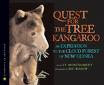
Recently I have been reading a lot of nonfiction. Within the last few years, I’ve been drawn to first-hand accounts of actual events. This book, however, caught my attention because of the gorgeous photographs. A Sibert Honor Book, Quest for the Tree Kangaroo: An Expedition to the Cloud Forest of New Guinea follows the story of Lisa Dabek, a scientist of animal behavior who focuses her study on the tree kangaroo, of which there are 10 kinds on the planet. In particular, this book concentrates on the Matschie’s (“MATCH-eez”) tree kangaroo, found on Papua New Guinea. It is one of the rarest mammals on the planet, and very difficult to locate. When Lisa’s fascination with tree kangaroos began when she saw them in a zoo, she was told that they cannot be tracked. Over many years, Lisa made it her goal to find the Matchie’s tree kangaroo and track them with radio collars that can signal movement and activity for up to 5 months before falling off. This particular expedition is by no means Lisa’s first, but it is the first time she and her team was able to briefly capture and collar several tree kangaroos. Her team consisted of experts from across the world, including a some help from villagers in Yawan village, field veterinarian, a zoologist, field scientists and field coordinators, an artist, a photographer, and the writer and author of this book, Sy Montgomery.

I could go on and on with details of their expedition including a history of Yawan village, but this book is truly worth reading yourself. The layout of the book is very well planned, with a high quality photograph and caption on just about every page; some pages are consumed with the photographs. I use the word “consumed” because the photograph takes over and pulls in its audience. New Guinea’s Cloud Forest is extraordinarily beautiful and full of life. The photographs document the expedition well, telling their own stories. On the other hand, the text certainly does justice to these photographs. With short sentences for young readers, there is a lot of information that is broken down as simply as possible. Without a particular science background, Sy Montgomery is revealing this story in plain language that is easy to understand. When telling this account, he considers the entire team, and not just his experiences in the Cloud Forest of New Guinea. Also, Lisa and hence her team have a very positive relationship with the community and village of Yawan. All of the villagers are friendly and supportive of their mission, going so far as to escort them up rocky slopes and across dangerous bridges.

Toward the end, Lisa give advice to kids on how to help conserve the environment, including studying their favorite animals, beach cleanups, and joining organizations like Wildlife Conservation Society. I recently shared this book with a fifth grade student who doesn’t like to read, and he was so excited about the pictures that he had me write down the title of the book so he could find it for himself in the library. He was blown away by the fact that there are kangaroos that live in the trees, as was I! As I said before, this is definitely a book worth reading, and no doubt worthy of the Sibert Award for informational books.